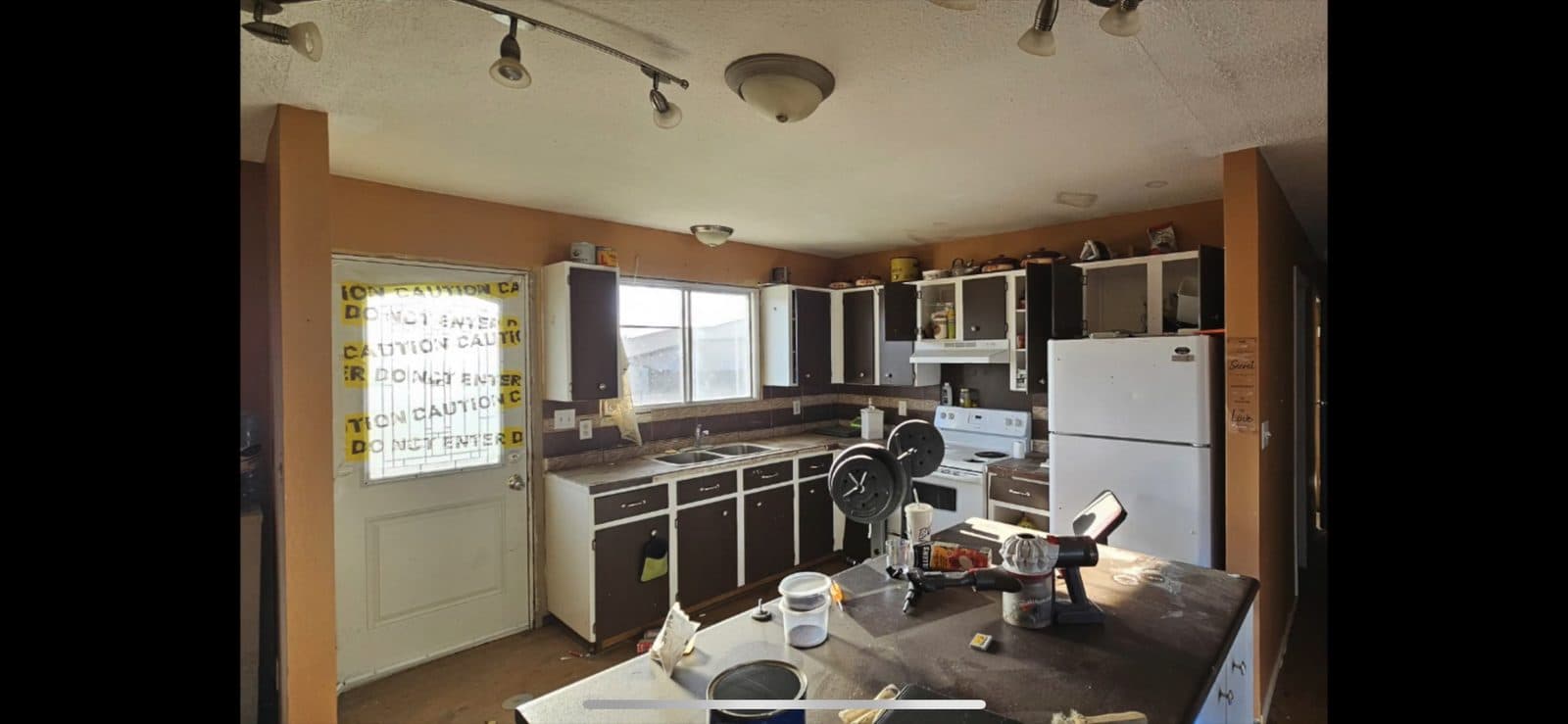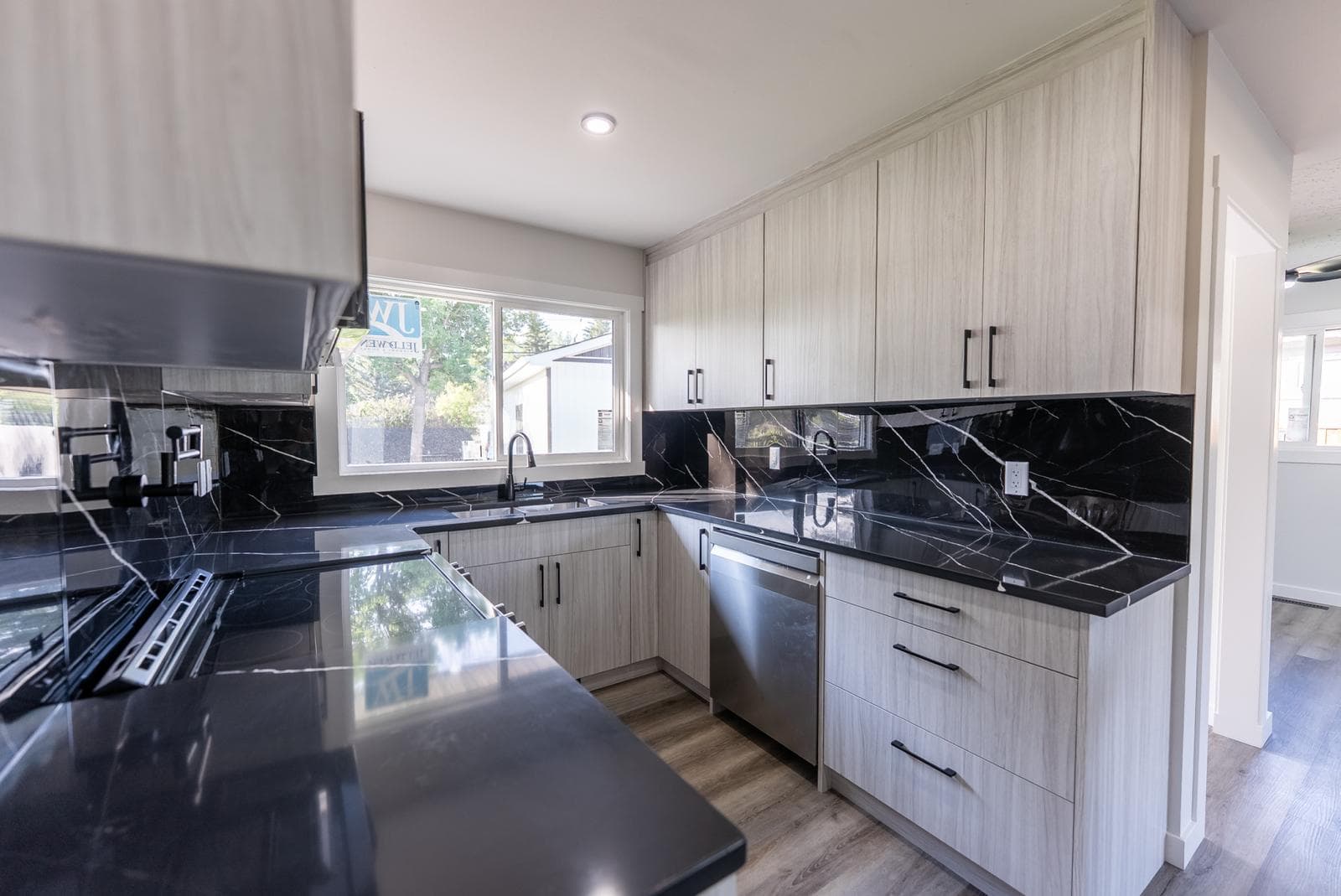
It's one of the most expensive decisions a Central Alberta homeowner faces: renovate before selling and potentially make more money, or sell as-is and let someone else take on the work? Get it wrong in either direction and you can leave $20,000–$80,000 on the table.
As a contractor that does both client renovations AND buys homes for cash to renovate ourselves, we see this decision from both sides daily. Here's the honest framework we use when Central Alberta homeowners ask us — and the questions you need to answer before committing either way.
The two paths and what they actually cost
Path A: Renovate, then sell on the open market
You hire a contractor, invest in renovations, list with a realtor, hope for a strong sale. The numbers look like:
- Renovation cost: variable, but typically $30,000–$150,000+ depending on scope
- Carrying costs during renovation: mortgage, utilities, taxes (typically $2,000–$5,000/month) for 2–6 months
- Realtor commissions at sale: typically 5–7% of sale price
- Closing costs, legal fees, staging: another 2–3%
- Capital gains tax (if not your primary residence)
Best-case scenario: renovations recover 80–100%+ AND attract premium buyers AND sell faster. You net meaningfully more than selling as-is.
Worst-case scenario: renovations go over budget, take longer than expected, market shifts during construction, the renovation choice doesn't appeal to buyers, or the sale drags on. You net less than if you'd just sold as-is at the start.
Path B: Sell as-is to an investor / cash buyer (we're one)
You sell directly to an investor (like us) or a cash buyer who takes on the renovation work themselves. The numbers look like:
- Sale price: lower than market value (typically 70–85% of after-renovation value)
- Renovation cost to you: $0
- Carrying costs: 0–30 days (quick closings)
- Realtor commissions: $0 (direct sale)
- Closing costs and legal: minimal
- Capital gains tax (if applicable): same as Path A
Best-case scenario: you close quickly, pocket the cash, move on with your life with zero hassle, zero renovation risk, zero stress about whether the renovation will recover.
Worst-case scenario: you got a lower price than you would have from a renovated open-market sale. The premium someone else pays comes with risk, time, and effort — the “discount” you accept is for the absence of those.
The decision framework: 8 questions to ask yourself
Question 1: How much time do I actually have?
Renovating before selling realistically takes 4–9 months end-to-end (scope, contractor selection, permits, construction, staging, listing, offers, closing). If you need to be out in 90 days — new job, divorce, financial pressure, relocation — the renovate-and-sell path is essentially off the table. As-is is your only realistic option.
If you have 12+ months and you're psychologically and financially ready to live through a renovation, the math changes significantly.
Question 2: What's the current condition of the home?
Cosmetic issues (dated paint, worn carpet, old fixtures) usually DO pay back. Structural issues, foundation problems, knob-and-tube wiring, asbestos, mold, or roofing failures often DO NOT pay back fully — because most buyers either won't touch the property, or will require a fix in negotiation anyway.
Counterintuitively: the worse the structural condition, the better as-is to an investor often is. Investors have crews and budget for major work; retail buyers don't. A home with serious issues sells for a steeper discount on the open market than to a cash investor who's expecting that work.
Question 3: Can I afford the renovation upfront?
Renovations require cash. Even with construction financing, you're funding the work before the sale recovers it. If paying for the renovation would require liquidating retirement accounts, taking on debt, or putting yourself in a financial stress position — the as-is path is dramatically lower risk.
Question 4: Do I have the energy and patience for a renovation?
Renovations are stressful. Living through one, or even managing one while you've moved out, drains time and emotional energy. If you're dealing with a major life event — job change, divorce, health issue, family situation, retirement transition — adding a renovation on top can be too much. The as-is path lets you move on cleanly.
Question 5: What's the local market doing?
In a hot seller's market, even unrenovated homes sell quickly at strong prices — reducing the marginal benefit of renovating. In a slow buyer's market, well-renovated homes stand out more — potentially increasing the benefit of renovating, but also increasing the risk of carrying costs if the sale drags.
Central Alberta's market shifts year by year. Talk to a local realtor about what's happening in your specific neighborhood before deciding.
Question 6: What's the renovation actually for?
There's a difference between:
- Necessary renovations — fixing things that will come up on inspection and either kill the sale or force a price reduction. These usually DO need to happen.
- Value-add renovations — kitchen, master ensuite, basement finish, etc. These MIGHT pay back depending on market and execution.
- “Luxury” renovations — ultra-premium finishes, custom features, lifestyle additions. These often DON'T pay back.
Be honest about which category your planned renovation falls into. Necessary renovations almost always pencil out. Luxury renovations almost never do at sale time.
Question 7: What's my opportunity cost?
If you take 6 months to renovate and sell instead of selling as-is in 4 weeks, that's 5 months of:
- Continuing mortgage payments on the old place
- Delayed move to the new place
- Delayed access to the equity locked in the old place
- Time and attention spent on the renovation instead of other things
For some sellers, those 5 months cost very little. For others (especially those moving for a job, dealing with health, or financially stretched), 5 months of opportunity cost can wipe out the renovation premium entirely.
Question 8: Is the home unique enough to justify renovation?
Cookie-cutter homes in established neighborhoods have a ceiling determined by comparable sales. If every house on your street sells for $450,000–$500,000, renovating yours to compete at $600,000 likely won't work — buyers shopping at $600,000 are looking in different neighborhoods.
Unique homes (acreages, lakefront properties, character homes, large lots) have less of a defined ceiling and reward investment more directly. Standard subdivision homes don't.
The middle path: minimal renovation + open-market sale
Often the smartest play isn't fully renovating OR selling raw as-is — it's strategic, minimal-investment prep work. Specifically:
- Fresh paint throughout (neutral colors)
- Deep professional clean
- Replace any obviously broken or dated fixtures (faucets, light fixtures, outlet covers)
- Curb appeal: front door paint, address numbers, basic landscaping cleanup
- Address any major obvious problems (cracked window, broken garage door, etc.)
- Pre-listing home inspection to identify deal-killers
Total investment: usually $5,000–$15,000. Typical recovery: 200–300%+ (you spend $10k, you sell for $25k+ more than you would have without the prep). This is the highest-ROI path for most homes — and the most commonly missed.
When as-is to an investor is the RIGHT answer
Selling as-is to a cash investor like us makes sense when:
- You need to close quickly (under 30–60 days)
- The home has significant condition issues (structural, foundation, major systems)
- You can't afford or don't want to fund renovations
- You're an out-of-province inheritor / executor who doesn't want to manage a renovation remotely
- The home is a rental property and you want OUT
- You're dealing with a divorce, financial pressure, or life event that requires speed
- The home was a flip / investment that didn't pan out
- You value certainty over maximum dollar return
The honest tradeoff: you get less money. You get it faster, with no hassle, no commissions, no surprises. For many sellers that tradeoff is worth it.
When the renovate-and-sell path is the RIGHT answer
- You have 6–18 months of timeline flexibility
- You have cash to fund the renovation OR access to construction financing
- The home is in a desirable neighborhood with strong comparable sales for renovated properties
- The renovations you're planning are well-targeted (kitchen, ensuite, basement suite, garage) rather than luxury or personalized
- You're psychologically ready to manage a renovation project
- You value maximum dollar return over certainty / speed
The middle ground we can help with
We're unusual among contractors because we operate both sides. We'll renovate your home for you if that's what makes sense. We'll also buy it as-is for cash if that's what makes sense for you. Sometimes the right answer isn't obvious until we've walked the property and talked through your situation.
We're not going to push you in either direction for our benefit. If we walk through your home and see that minimal prep work + open-market listing nets you significantly more than our cash offer, we'll tell you. If we see major issues that will tank an open-market sale and our offer puts more in your pocket faster, we'll explain that too.
Honest conversation, both options on the table, no pressure either direction. Reach out for a free walk-through and quote on whichever path you're leaning.